
Englit
Hub
The Hub of English Literature & Grammar

CLASS
CLASS
CLASS

CLASS
CLASS
CLASS
CLASS
CLASS

GRAMMAR



Chapter Heading
1. Form Classes, Structure Words and Determiners ..
2. Articles
3. Auxiliary Verbs
4. Time and Tense
5. Non-finites
6. Question Tags
7. Emphatic With Do/Does/Did.
8. Interchange of Affirmative and
Negative Sentences.
9. Interchange of Interrogative and
Assertive Sentences
10. Interchange of Exclamatory and
Assertive Sentences
11. Removal of Too'
12. Degrees of Comparison
13. The Clause and the Complex Sentence
14. Voice
15. Direct and Indirect Speech
16. Subject-Verb Agreement
17. Phras al Verbs..
18. Prepositions
19. Punctuation and the Use of Capital Letters
20. Common Errors
COMPOSITION
- Notice Writing
- Letter Writing (Formal and Informal)
- Essay Writing
- Article Writing
- Report Writing
- Speech Writing
- Debate Writing
- Story Writing (Narrative)
- Dialogue Writing
- Descriptive Paragraph Writing
- Biographical Sketch
- Character Sketch
- Email Writing
- Blog Writing
- Review Writing (Book/Movie/Play)
- Application Writing
- Precis Writing
- Argumentative Essay
- Expository Essay
- Reflective Essay
Spoken
Mastering Spoken English: A Comprehensive Guide
- Basics of Spoken English
- Conversation Skills
- Building a Strong Vocabulary
- Polite and Effective Communication
- Public Speaking
- Conversational Etiquette
- Cultural Sensitivity in Communication
- Common Challenges and Solutions
- Real-Life Scenarios and Role-Playing Exercises

Abhijeet Aryan
Founder & Author
google-site-verification: google85199de4bb243d33.html
Introduction to English Literature


Definition of Literature
Literature refers to written works, especially those considered to have artistic or intellectual value. It encompasses various forms such as novels, poetry, drama, essays, and short stories, created for the purpose of expression, communication, and reflection on the human experience. Literature often explores themes, characters, and ideas, providing insights into different cultures, societies, and historical periods. It serves as a means of entertainment, education, and cultural preservation, offering readers opportunities for empathy, imagination, and critical thinking.
साहित्य लिखित कार्यों को संदर्भित करता है, विशेष रूप से वे जिन्हें कलात्मक या बौद्धिक मूल्य माना जाता है। इसमें उपन्यास, कविता, नाटक, निबंध और लघु कथाएँ जैसे विभिन्न रूप शामिल हैं, जो मानव अनुभव पर अभिव्यक्ति, संचार और प्रतिबिंब के उद्देश्य से बनाए गए हैं। साहित्य अक्सर विषयों, पात्रों और विचारों की खोज करता है, विभिन्न संस्कृतियों, समाजों और ऐतिहासिक अवधियों में अंतर्दृष्टि प्रदान करता है। यह मनोरंजन, शिक्षा और सांस्कृतिक संरक्षण के साधन के रूप में कार्य करता है, पाठकों को सहानुभूति, कल्पना और आलोचनात्मक सोच के अवसर प्रदान करता है।

Introduction to
English Literature
English literature is a vast and rich field encompassing works written in the English language throughout history. It includes a diverse range of genres, styles, and themes, reflecting the social, cultural, and political contexts of different periods. Some key periods and movements include Old English literature (e.g., Beowulf), the Renaissance (e.g., Shakespeare), the Romantic era (e.g., Wordsworth, Keats), the Victorian era (e.g., Dickens, Brontë), modernism (e.g., Joyce, Woolf), and postmodernism (e.g., Rushdie, Atwood). Studying English literature offers insights into human experiences, emotions, and ideas, and helps us understand the evolution of language and storytelling over time.
अंग्रेजी साहित्य एक विशाल और समृद्ध क्षेत्र है जिसमें पूरे इतिहास में अंग्रेजी भाषा में लिखी गई रचनाएँ शामिल हैं। इसमें विभिन्न प्रकार की विधाएँ, शैलियाँ और विषय शामिल हैं, जो विभिन्न अवधियों के सामाजिक, सांस्कृतिक और राजनीतिक संदर्भों को दर्शाते हैं। कुछ प्रमुख अवधियों और आंदोलनों में पुराना अंग्रेजी साहित्य (जैसे, बियोवुल्फ़), पुनर्जागरण (जैसे, शेक्सपियर), रोमांटिक युग (जैसे, वर्ड्सवर्थ, कीट्स), विक्टोरियन युग (जैसे, डिकेंस, ब्रोंटे), आधुनिकतावाद (जैसे, जॉयस, वूल्फ) और उत्तर आधुनिकतावाद (जैसे, रुश्दी, एटवुड) शामिल हैं। अंग्रेजी साहित्य का अध्ययन मानवीय अनुभवों, भावनाओं और विचारों के बारे में अंतर्दृष्टि प्रदान करता है, और समय के साथ भाषा और कहानी कहने के विकास को समझने में हमारी मदद करता है।
Defferent Age of English Literature
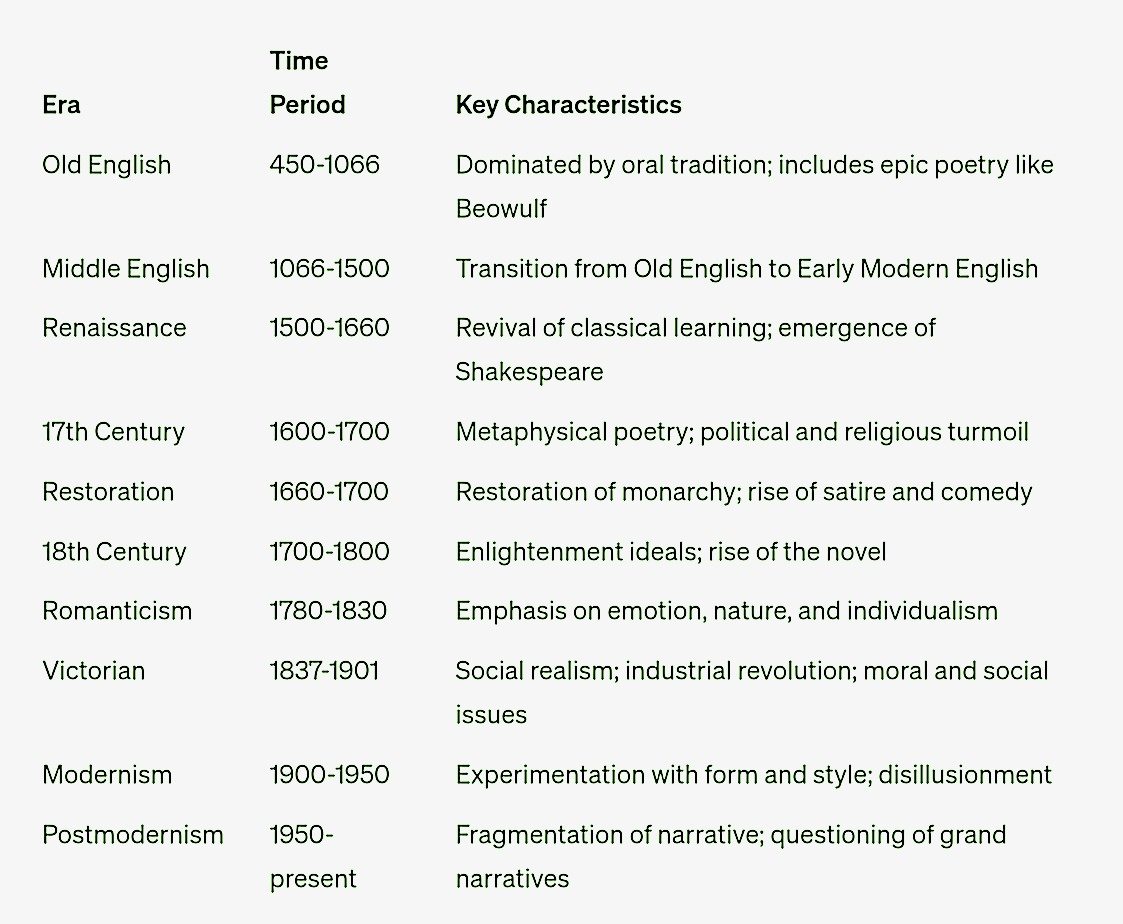
Figure of Speech

Figure of speech refers to a rhetorical device or linguistic technique used to convey meaning in a creative or expressive way beyond the literal interpretation of words. Here are some common figures of speech:
- Simile: A comparison between two unlike things using "like" or "as." Example: "Her smile is as bright as the sun."
- Metaphor: A direct comparison between two unrelated things, implying similarity. Example: "Time is a thief."
- Personification: Attributing human characteristics to non-human entities or objects. Example: "The trees whispered secrets in the wind."
- Hyperbole: Exaggeration for emphasis or effect. Example: "I've told you a million times."
- Alliteration: Repetition of initial consonant sounds in neighboring words. Example: "Peter Piper picked a peck of pickled peppers."
- Onomatopoeia: Words that imitate the sound they represent. Example: "Buzz," "Hiss," "Boom."
- Irony: A contrast between what is expected and what actually happens, often used for humor or emphasis. Example: "The fire station burned down."
- Oxymoron: A combination of contradictory terms. Example: "Bittersweet," "Jumbo shrimp."
- Litotes: Understatement achieved by denying the opposite of what is meant. Example: "He's not the brightest bulb in the box."
- Anaphora: Repetition of a word or phrase at the beginning of successive clauses or sentences. Example: "We shall fight on the beaches, we shall fight on the landing grounds, we shall fight in the fields and in the streets..."
These figures of speech add depth, imagery, and emotion to language, making communication more vivid and engaging.
more examples of figures of speech:
- Assonance: Repetition of vowel sounds within nearby words. Example: "The rain in Spain falls mainly on the plain."
- Consonance: Repetition of consonant sounds within nearby words. Example: "Pitter-patter, pitter-patter."
- Metonymy: Substitution of the name of one thing with something closely associated with it. Example: "The pen is mightier than the sword."
- Synecdoche: A part of something is used to represent the whole, or vice versa. Example: "All hands on deck" (where "hands" represent sailors).
- Euphemism: Substitution of a mild or indirect expression for one that is considered harsh or blunt. Example: "He passed away" instead of "He died."
- Allusion: A reference to a well-known person, place, event, or work of literature. Example: "She had a smile like Mona Lisa."
- Cliché: Overused expression or phrase that has lost its originality and impact. Example: "Time heals all wounds."
- Paradox: A statement that appears self-contradictory but may reveal a deeper truth. Example: "Less is more."
- Chiasmus: Reversal of grammatical structures in successive phrases or clauses. Example: "Ask not what your country can do for you; ask what you can do for your country."
- Antithesis: Contrast of ideas expressed in a parallel grammatical structure. Example: "It was the best of times, it was the worst of times."
These examples demonstrate the variety and versatility of figures of speech in language, enhancing communication through creativity and expressiveness.
Genres of Literature

Literature encompasses a diverse range of genres, each with its own unique characteristics and conventions. Here are some of the main genres:
- Fiction:
- Novel: A long-form narrative prose fiction that typically explores complex characters, plotlines, and themes.
- Short Story: A brief fictional narrative focusing on a single event, character, or mood.
- Flash Fiction: Extremely brief works of fiction, often with a word count of under 1000 words.
- Poetry:
- Lyric Poetry: Short, emotionally expressive poems often focused on personal thoughts and feelings.
- Epic Poetry: Long narrative poems that recount heroic deeds and adventures.
- Sonnet: A fourteen-line poem, usually with a specific rhyme scheme and meter.
- Drama:
- Tragedy: Plays that depict the downfall of a protagonist due to a tragic flaw or external circumstances.
- Comedy: Humorous plays that typically end happily or with reconciliation.
- Tragicomedy: Blends elements of tragedy and comedy, often exploring serious themes with humor.
- Nonfiction:
- Essay: Short prose pieces that explore a particular topic or idea from the author's perspective.
- Biography: An account of a person's life written by someone else.
- Autobiography: An account of a person's life written by themselves.
- Diverse Forms:
- Fantasy: Fictional works set in imaginary worlds with magical elements and fantastical creatures.
- Science Fiction: Speculative fiction that explores futuristic or alternative realities, often with scientific or technological elements.
- Historical Fiction: Fiction set in the past, often featuring real historical events or figures.
- Mystery/Thriller: Stories focused on solving a puzzle or crime, often with suspenseful or thrilling element.
Here are some additional genres of literature:
- Horror:
- Gothic Fiction: Features elements of horror, romanticism, and the supernatural, often set in eerie or mysterious environments.
- Psychological Thriller: Focuses on the psychological aspects of fear and suspense, often delving into the minds of characters.
- Romance:
- Historical Romance: Set in the past and often featuring romantic relationships amidst historical events or settings.
- Contemporary Romance: Set in the present day and focuses on romantic relationships in modern contexts.
- Adventure:
- Action-Adventure: Features fast-paced action and thrilling adventures, often with heroic protagonists.
- Survival: Focuses on characters' efforts to survive in challenging or hostile environments.
- Humor:
- Satire: Uses humor, irony, and exaggeration to critique and ridicule societal or political issues.
- Parody: Imitates the style of a particular work or genre for comedic effect.
- Children's Literature:
- Picture Books: Illustrated books for young children, often with simple stories and colorful artwork.
- Middle Grade: Targeted at children aged 8-12, typically featuring more complex plots and themes.
- Young Adult (YA): Geared towards teenagers, addressing themes relevant to adolescence and coming-of-age experiences.
Poetic/Literary Devices
Poetic devices, also known as literary devices, are techniques and tools that poets use to enhance the meaning, sound, and imagery of their poetry. Here are some common poetic devices:
- Alliteration: Repetition of initial consonant sounds in neighboring words. Example: "Peter Piper picked a peck of pickled peppers."
- Assonance: Repetition of vowel sounds within nearby words. Example: "The rain in Spain falls mainly on the plain."
- Consonance: Repetition of consonant sounds within nearby words. Example: "Pitter-patter, pitter-patter."
- Rhyme: Correspondence of sound between words or the endings of words, often at the end of lines in poetry. Example: "I wandered lonely as a cloud / That floats on high o'er vales and hills."
- Meter: Regular pattern of stressed and unstressed syllables in a line of poetry. Example: "Shall I compare thee to a summer's day? / Thou art more lovely and more temperate."
- Metaphor: Comparison between two unlike things, implying similarity. Example: "Time is a thief."
- Simile: Comparison between two unlike things using "like" or "as." Example: "Her eyes sparkled like diamonds."
- Personification: Attribution of human characteristics to non-human entities or objects. Example: "The trees whispered secrets in the wind."
- Hyperbole: Exaggeration for emphasis or effect. Example: "I've told you a million times."
- Onomatopoeia: Words that imitate the sound they represent. Example: "Buzz," "Hiss," "Boom."
- Imagery: Vivid descriptive language that appeals to the senses, creating mental images for the reader. Example: "The sky was a deep shade of indigo, streaked with wisps of silver clouds."
- Symbolism: Use of symbols to represent ideas, concepts, or qualities. Example: A dove symbolizing peace.
These poetic devices help poets convey their messages more effectively and create memorable and impactful poetry.


About
Us

Welcome to EnglitHub! 🌟
Dive into the world of English mastery with EnglitHub, the brainchild of Abhijeet Aryan, your guide and mentor in the journey of language enlightenment. As the founder and author, Abhijeet brings his passion for English education to life, making learning an enriching experience for all.
At EnglitHub, we open the gates to a treasure trove of resources designed to empower learners of all levels. From class 5 to 12, we provide comprehensive access to NCERT books, coupled with insightful explanations and Hindi translations to demystify every word. Delve into our vast repository featuring external question answers, exam guides, and NCERT solutions, meticulously curated to elevate your academic journey.
But EnglitHub is more than just a platform for exam preparation; it's a beacon of linguistic empowerment for all. Whether you're a student gearing up for board exams or a language enthusiast seeking to hone your skills, EnglitHub welcomes you with open arms. And the best part? Accessing our wealth of knowledge is absolutely free!
Join us in the pursuit of linguistic excellence. Let EnglitHub be your companion on the path to proficiency, where grammar intricacies and spoken nuances are unravelled with finesse. Together, let's embark on a journey where language knows no bounds, and learning knows no limits.
Unlock the door to linguistic brilliance. Welcome to EnglitHub – where learning English is an adventure worth embarking on!
Abhijeet Aryan